Digital fraud growth in Latin America
40%
According to the source article, fraud in digital channels in Latin America grew 40% in 2023, driven by digital adoption and increasingly connected banking ecosystems.
Reference architecture
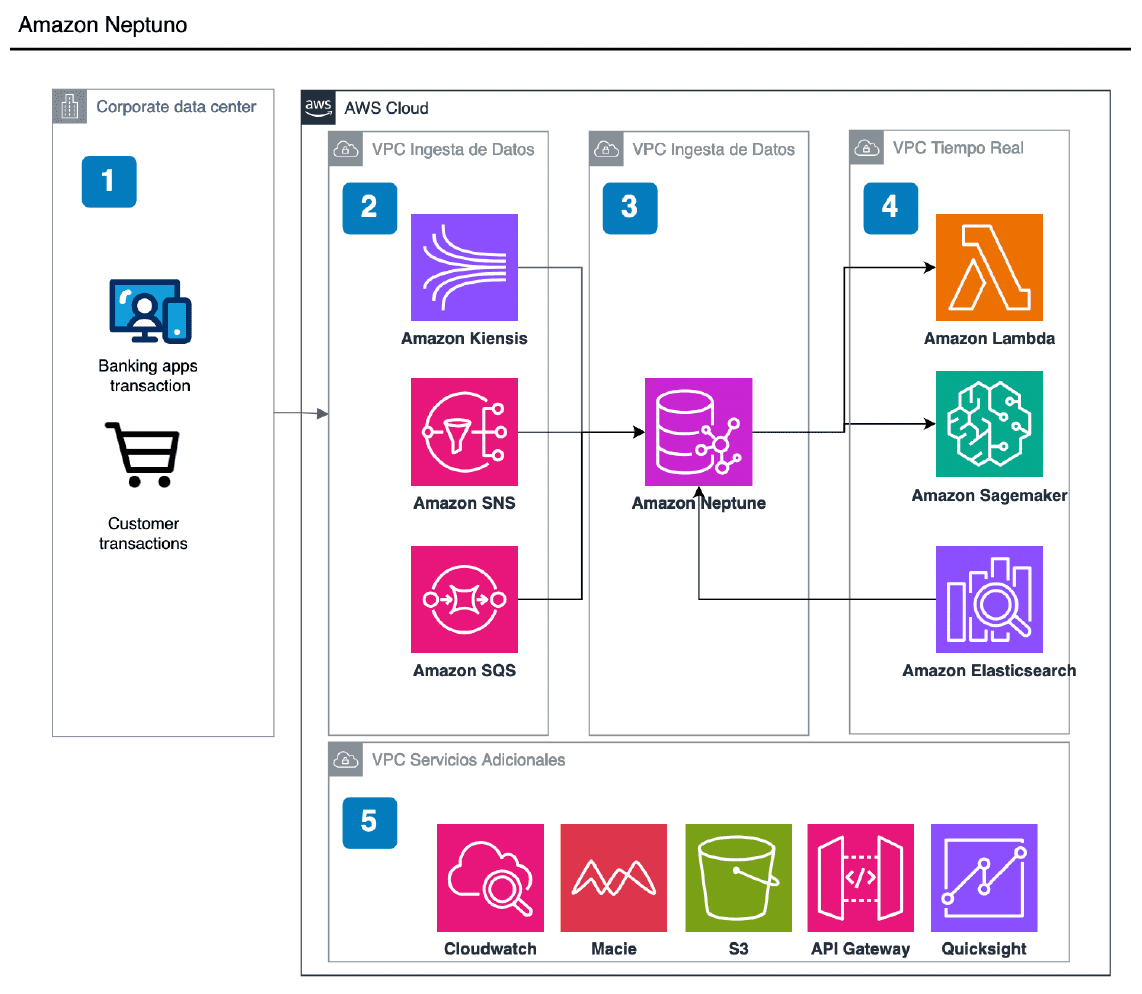
The source document proposes a fraud-detection architecture centered on Amazon Neptune, with real-time ingestion through Kinesis/SNS/SQS and downstream processing with Lambda, SageMaker, OpenSearch, S3, API Gateway and QuickSight.
Fraud is not only a transaction problem
In financial services, fraud rarely appears as a single isolated event. It emerges through relationships: one device used across multiple accounts, one location linked to unusual activity, one identity interacting with several channels, or one transaction pattern that only becomes suspicious when connected to others.
That is why traditional approaches often fall short. They are effective at checking rules on individual events, but weaker at understanding the network around them.
Why graphs matter
Graph-based models are useful because fraud is relational by nature.
A graph allows the institution to represent customers, accounts, devices, transactions, locations and channels as connected entities. Once those relationships are visible, hidden patterns become easier to detect in real time.
- Shared devices across multiple accounts
- Suspicious transaction chains between related entities
- Unusual geolocation and access correlations
- Repeated behavioral patterns across channels
Why Amazon Neptune fits this problem
The source article proposes Amazon Neptune as the core graph engine for fraud detection, allowing the bank to model complex relationships and run advanced graph queries in real time.
That matters because the fraud problem is not only about storing data. It is about traversing connections quickly enough to support decisions while the transaction is still live.
A practical operating architecture
The architecture in the source document is useful because it is not just a database view. It is an operating flow.
- Banking channels and transaction systems generate the events
- Kinesis or SNS/SQS capture suspicious or relevant events in real time
- Neptune stores the graph of customers, accounts, devices, transactions and locations
- Lambda executes rule-based analysis and graph lookups
- SageMaker validates anomalies through machine learning models
- OpenSearch supports historical log analysis for security teams
- S3 stores transaction and graph data for audit and long-term analysis
- QuickSight provides monitoring and operational dashboards
This is powerful because it combines event processing, graph intelligence, machine learning and operational observability in one flow.
Where this creates value for banks
A graph-based fraud approach improves more than detection accuracy. It changes the speed and quality of institutional response.
- Earlier detection of suspicious behavior
- Better visibility across channels
- Improved analyst investigation workflows
- Lower false positives through richer contextual analysis
- Stronger auditability and traceability
Security, compliance and scalability still matter
The source architecture also highlights IAM, KMS, Shield, WAF, Elastic Load Balancing and Auto Scaling. That is important because fraud systems in banking cannot be designed as isolated analytics experiments.
They must operate under security controls, regulatory requirements and changing transaction volumes.
The strategic point
Graph intelligence is not just a technical enhancement for fraud teams. It is a better way to understand the bank as a network of relationships rather than a sequence of disconnected events.
That shift matters because financial crime increasingly exploits fragmentation between channels, systems and controls. A graph-based architecture helps restore that missing context.
The banks that improve fraud detection will not be the ones with the most rules. They will be the ones that understand relationships faster, act with better context and operationalize detection in real time.